
Fire Risk Assessments (FRAs) your obligations as a landlord
If you are a landlord, you have legal responsibilities for fire safety. These duties will vary depending on the type of property you own or manage, but in all cases they are enforceable and taken seriously by regulators, insurers, and fire authorities.
Fire Risk Assessments (FRAs) sit at the centre of these obligations. A missing, outdated, or inadequate FRA can expose tenants to harm and landlords to prosecution, fines, and invalidated insurance.
This article explains what an FRA is, who is responsible, which parts of a building must be assessed, and how landlords can take practical steps to reduce fire risk.
Why fire risk matters for landlords
Fire in residential property is rarely a minor incident; even where no one is injured, smoke damage, structural repairs, and emergency response costs can run into tens or hundreds of thousands of pounds. For landlords, there is also the risk of enforcement action, civil claims, and long-term loss of rental income.
Most residential fires start in kitchens and are linked to everyday activities rather than deliberate misuse. This makes prevention, early detection, and clear escape routes especially important in rented accommodation, where occupants may be unfamiliar with the building, or each other.
Most residential fires start in kitchens and are linked to everyday activities rather than deliberate misuse. This makes prevention, early detection, and clear escape routes especially important in rented accommodation – particularly HMOs – where occupants may be unfamiliar with the building, or each other.
What is a Fire Risk Assessment?
A Fire Risk Assessment is a structured review of a building to identify fire hazards, understand who may be harmed, and decide what measures are needed to reduce risk to an acceptable level.
In practical terms, an FRA helps landlords answer the following questions:
- What could cause a fire?
- If a fire does occur, who would be affected?
- How likely is it, and how severe could the consequences be?
- What controls are already in place, and what needs improvement?
The outcome should be a written record (where required), an action plan, and a clear review schedule.
Who is responsible for carrying out an FRA?
The law places responsibility on the “responsible person”. This is not a job title, but a legal role.
In most cases, the responsible person is the individual or organisation that either owns the building, or has control of the premises (such as through a managing agent, or a management contract).
In blocks of flats, responsibility often sits with the freeholder or managing agent for communal areas, while individual flat owners retain duties within their own residences.
Where responsibilities are unclear, it’s important to review lease agreements carefully: ambiguity does not remove legal liability.
If you’re unsure of your obligations, you can check official guidance from the UK Government here: People with duties under fire safety laws (GOV.UK)
Can landlords carry out their own Fire Risk Assessments?
In some cases, landlords are permitted to carry out their own Fire Risk Assessments, but only if they are considered competent to do so. Competence, in this context, means having sufficient knowledge, training, and experience to identify fire hazards, assess risk accurately, and understand appropriate control measures for the specific type of building involved.
Government guidance makes clear that competence is not defined by holding a formal qualification alone. A landlord must understand relevant fire safety legislation, building construction, means of escape, fire detection systems, and the needs of residents.
The assessment must also be “suitable and sufficient”; a generic checklist or poorly completed template is unlikely to meet this requirement, particularly in more complex buildings.
For simple, low-risk properties, such as single-occupancy dwellings with straightforward layouts, a competent landlord may be able to complete an FRA themselves using official guidance.
When should a professional fire risk assessor be used?
A professional fire risk assessor should be used where a building is complex, higher risk, or where the landlord does not have demonstrable fire safety knowledge and experience. This typically includes blocks of flats, HMOs, buildings with shared fire detection or smoke control systems, properties with external wall systems or balconies, and accommodation for housing older or vulnerable residents.
In these cases, the level of technical judgement required goes beyond what can reasonably be expected of a layperson. It’s important to note that while appointing a professional doesn’t transfer legal responsibility away from the landlord, it significantly reduces the risk of an inadequate assessment and provides evidence that reasonable steps have been taken to comply with fire safety law.
Which parts of a building must be covered by an FRA?
For residential buildings, an FRA must cover:
- The structure and external walls of the building (such as cladding, balconies, and windows)
- Common parts, such as stairwells and corridors
- Entrance doors to flats that open into communal areas
It’s essential to review property leases to clarify responsibility. Some elements, such as balconies or windows, may fall under leaseholder obligations rather than those of the freeholder or managing agent.
The UK legal framework for fire safety
The Regulatory Reform (Fire Safety) Order 2005 outlines fire safety laws for landlords, requiring them to conduct Fire Risk Assessments (FRAs) to identify and mitigate fire hazards. However, fire safety laws have evolved since then, particularly in the wake of the Grenfell Tower disaster. The Fire Safety Act 2021 now strengthens requirements, especially for residential buildings, ensuring that common areas, entrance doors, and external building elements are properly assessed.
Together, these require responsible persons to ensure that fire risks are identified, managed, and reviewed on an ongoing basis. An FRA must be appropriate to the building and its occupants; a generic or outdated assessment is unlikely to be acceptable.
How to conduct a Fire Risk Assessment

An FRA assesses:
- Fire hazards – what could start a fire?
- Who is at risk – tenants, visitors, neighbours?
- Risk likelihood and severity – what are the chances, and what could happen?
- Preventative measures – how can fire risks be reduced?
FRAs typically categorise risks into low, medium, and high levels, each requiring action within specific timeframes. Assessments must be reviewed regularly, especially if significant changes occur within the building.
If a fire were to break out, authorities will ask: “Where is the FRA, and when was it last reviewed?” Regular updates ensure ongoing compliance and safety.
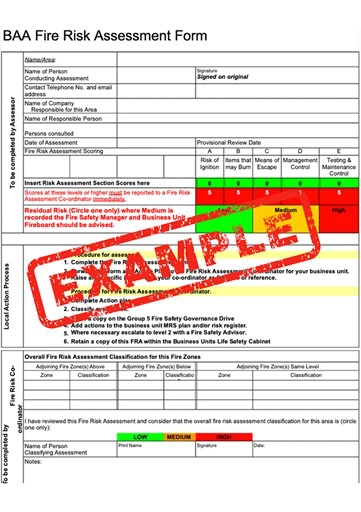
If you’re a landlord who owns a low-risk property with a simple layout and are satisfied that you fulfil the criteria for competence, then you can conduct an FRA using templates or checklists for guidance (like this UK government fire risk assessment checklist).
If you need to dig deeper into the finer details of the FSO 2005, then you access it here: The Regulatory Reform (Fire Safety) Order 2005 – legislation.gov.uk
and the Fire Safety Act 2021 can be viewed here: Fire Safety Act 2021 – legislation.gov.uk
Six key fire safety measures for landlords
Here are six essential fire safety measures that you should have in place in your properties:
1. Maintain clear fire escapes
Ensure emergency exits are clearly marked, well-lit, and free from obstructions. Fire doors should be in good condition, and self-closing mechanisms must function properly.
2. Manage fire hazards
- Keep ignition sources (such as cookers and heaters) away from flammable materials
- Ensure tenants don’t overload electrical sockets
- Regularly check gas and electrical installations for safety compliance
3. Install and maintain smoke alarms
- In England, landlords must install at least one smoke alarm per floor and a carbon monoxide alarm in rooms with solid fuel-burning appliances
- In Scotland, interlinked smoke and heat alarms have been mandatory in all dwellings since February 2022
4. Fire safety signage and emergency plans
Provide clear fire safety instructions in communal areas. If you have tenants who speak different languages, consider pictorial signs.
5. Fire action plan
Ensure that your tenants understand:
- Evacuation procedures
- Fire assembly points
- Stay-put policies (if applicable)
6. Regular FRA reviews
Although the law doesn’t stipulate the review period for FRAs, it’s important to update them whenever there are changes, such as:
- Structural modifications
- New government fire safety legislation
- Fire safety systems are altered or upgraded
- New tenants with additional safety needs (such as mobility impairments)
How to reduce fire risk in rental properties
Here are practical steps that landlords can take to ensure fire safety:
✅ Install smart fire prevention devices
A stove guard like Airis automatically shuts off the hob if it detects dangerous conditions, preventing kitchen fires before they start.
✅ Keep corridors and escape routes clear
Ensure that tenants do not store bikes, furniture, or rubbish in escape routes.
✅ Provide fire safety equipment
Supply fire blankets and extinguishers in shared areas (but also ensure that tenants are trained on how to use them properly).
✅ Consider special fire alarms for vulnerable tenants
Hard-of-hearing tenants may need visual or vibrating alarms instead of standard smoke detectors.
✅ Schedule regular safety inspections
Check electrical and gas safety certificates annually and ensure compliance with regulations.
Free fire safety resources for vulnerable tenants
Did you know that older people in sheltered housing or those with disabilities are entitled to a free home fire safety visit from their local Fire and Rescue Service? These visits assess home risks, provide fire prevention advice, and even include free smoke alarm installations where needed.
For landlords managing vulnerable tenants, this is an excellent service to take advantage of. You can learn more by contacting your local fire service.
The consequences of non-compliance
Aside from the obvious risks to life, failing to comply with fire safety laws can have severe repercussions:
- Fines of up to £5,000 for minor breaches
- Unlimited fines or imprisonment for serious violations
- Invalidated insurance policies if fire safety regulations are not met
- Potential legal action from tenants for unsafe living conditions
Given these risks, taking fire safety seriously is essential for all landlords.
Final thoughts
Fire safety is not just about compliance—it’s about protecting lives and property. Landlords must take a proactive approach by conducting regular Fire Risk Assessments, maintaining fire safety equipment, and ensuring tenants are well-informed.
By investing in smart fire prevention devices like Airis, keeping escape routes clear, and using up-to-date smoke alarms, you can significantly reduce the risk of fire in your rental property.
Stay compliant, stay safe, and protect your investment.
If you have questions, we’re here to help
We can call you back, or you can contact us by phone on 0208 798 3462 or click on ‘Contact Us’ to send us a message.

Rated 5 stars by our customers

FAQ: Fire Risk Assessments for landlords
Do all landlords need a Fire Risk Assessment?
Most do, particularly where buildings contain common areas or are used for non-domestic purposes. Responsibilities vary by property type.
Can a landlord carry out their own FRA?
Yes, for simple properties, provided they are competent. More complex buildings usually require a professional assessor.
Does an FRA cover inside individual flats?
FRAs under the Fire Safety Order focus on common parts, but landlords still have wider duties for fire safety within dwellings.
How long is an FRA valid for?
There is no expiry date. It remains valid only while it reflects the building and its use accurately.
What happens if an FRA is missing or inadequate?
Fire authorities can issue enforcement notices or prosecute, and insurers may refuse to pay out after a fire.